
If you're researching composite veneers cost, the short answer is that composite veneers usually cost about $250 to $1,500 per tooth in the United States. The total depends on how many teeth are treated, how much reshaping is needed, and the dentist's experience.
If you're comparing veneer materials or wondering which option best matches your goals for color and shape, veneers & laminates can clarify the differences and expected results. Smile Line Dentistry in Livermore, CA helps patients understand options, likely outcomes, and realistic costs so you can make a confident choice.
Composite veneers are thin layers of tooth-colored resin placed on the front of teeth. They are commonly used to improve discoloration, small chips, minor gaps, uneven edges, or slight shape differences.
Some offices quote a fee per tooth, while others quote for several teeth that show when you smile. Multiplying the per-tooth fee by the number of teeth gives a rough starting point, but the final total may change based on planning, bite adjustments, and whether the office offers package pricing.
Before starting treatment, ask what the estimate includes. It is helpful to confirm whether X-rays or scans, anesthesia, polishing, and follow-up adjustments are part of the quoted fee.
For a broader overview of pricing, see veneers cost. If you're weighing composite bonding specifically, see bonding vs. veneers.
The biggest cost differences usually come from time, technique, and case difficulty. A simple repair on one tooth costs less than reshaping several front teeth for a balanced smile.
Matching one front tooth can also be technically demanding. The dentist may need to recreate color, translucency, contour, and surface texture so the tooth blends with nearby natural teeth.
Other factors that can change the fee include:
Some composite veneers can be completed in one visit with little or no enamel removal. More involved cases may need photos, study models, a trial design, or more than one appointment, which can increase the total cost.
Composite veneers usually cost less upfront than porcelain veneers. A lower starting price does not always mean a lower long-term cost. Composites may need more polishing, touch-ups, or replacement over time; see how long veneers last for more on longevity.
|
Feature |
Composite Veneers |
Porcelain Veneers |
|---|---|---|
|
Typical U.S. fee |
About $250 to $1,500 per tooth |
Often about $900 to $2,500 or more per tooth |
|
Placement |
Usually applied directly by a dentist |
Commonly made by a dental laboratory |
|
Visits |
Often one visit |
Usually two or more visits |
|
Enamel removal |
Often minimal or none, but varies |
Commonly requires some preparation |
|
Stain resistance |
Lower |
Higher |
|
Repair |
Often repairable in the mouth |
Chips may require laboratory repair or replacement |
|
Expected service |
Commonly several years with good care |
Often longer, but not permanent |
These are general ranges, not guaranteed fees. A dental exam is the best way to tell whether composite or porcelain is likely to give a healthy, stable result.
Dental insurance usually does not cover veneers placed only to improve appearance. In some cases, resin treatment may be considered when a tooth has been damaged by decay or injury, but coverage depends on the plan's rules and documentation requirements.
Ask the office for procedure codes and a pretreatment estimate from the insurer. For broader plan information, see dental insurance options.
Preauthorization is not a guarantee of payment, so check deductibles, annual maximums, waiting periods, and exclusions before you move forward. If financing is offered, compare the full repayment amount, not just the monthly payment.
Composite veneers commonly last about four to eight years, though some last less time and others remain serviceable longer. Their lifespan depends on bite forces, oral hygiene, diet, grinding habits, and how much of the tooth is being rebuilt.
Composites can stain, lose shine, chip, or wear down over time. Coffee, tea, tobacco, red wine, and strongly pigmented foods can affect color, while chewing ice, biting pens, or eating very hard foods can increase the risk of fractures.
Regular exams help a dentist check the veneer edges, bite, tooth structure, and gum health. Routine cleanings & prevention visits and occasional polishing may help with surface staining, but deeper discoloration or larger damage may require repair or replacement.
Composite veneers can work well for small cosmetic changes, but they are not right for every situation. Untreated cavities, active gum disease, very thin enamel, severe crowding, major tooth damage, or heavy grinding may make another treatment safer or more predictable.
A veneer should not cover up a problem that still needs diagnosis. For example, a dark tooth may be discolored because of decay, past trauma, or inflammation inside the tooth rather than a surface stain alone.
Some people may be better served by whitening, orthodontic treatment, a crown, or simple edge bonding. For a direct comparison, see crowns vs. veneers.
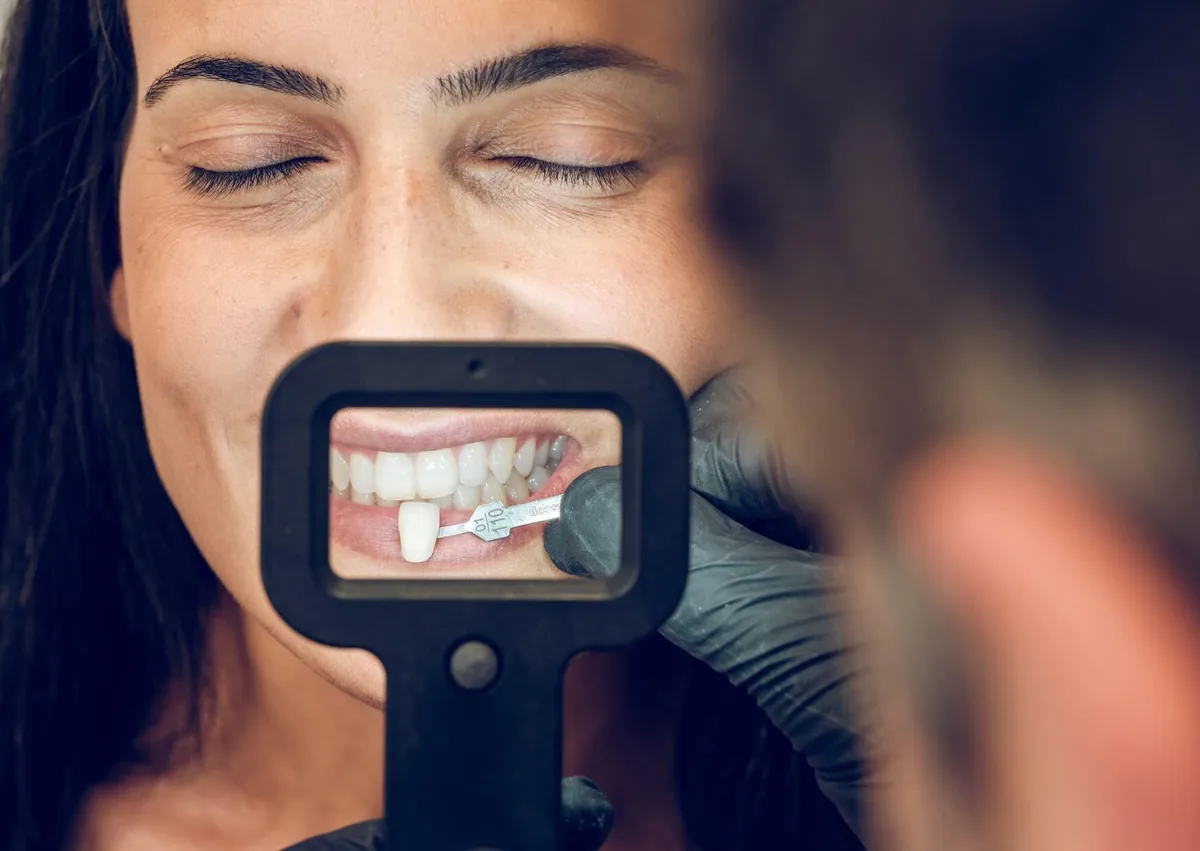
Composite veneers can improve color and symmetry, but they do not behave exactly like porcelain. They are generally more prone to staining and may not reflect light in quite the same way as natural enamel or porcelain.
Brush twice a day with fluoride toothpaste and clean between the teeth daily. Use a soft-bristled toothbrush, and avoid abrasive whitening products unless your dentist recommends them.
If you grind or clench your teeth, a custom night guard may help reduce the risk of chipping. Keep regular dental visits and report roughness, a changed bite, new staining, or a loose edge before the problem gets worse.
Contact a dentist if a veneer chips, loosens, feels rough, or causes ongoing sensitivity. Bleeding gums around one tooth, pain when biting, swelling, or a bad taste may point to a problem that needs more than cosmetic polishing.
Seek urgent dental care for severe or worsening pain, facial swelling, fever with dental symptoms, pus, or trouble opening the mouth. Difficulty breathing or swallowing, swelling near the eye or neck, or rapidly spreading facial swelling requires emergency medical care.
A proper consultation should include an exam of the teeth, gums, enamel, and bite, along with a written treatment plan. That is the most reliable way to get a realistic composite veneers cost estimate and decide whether the treatment makes sense for your situation.
A consultation lets your dentist assess teeth, discuss whether composite or porcelain is best, and provide a written estimate tailored to your needs. Call Smile Line Dentistry for veneers & laminates in Livermore, CA at (925) 456-7600 to book a visit or request online availability.
Yes. Composite veneers usually have a lower initial cost because they are often placed directly by the dentist and may not require laboratory fabrication.
Porcelain usually costs more, but it may offer better stain resistance and a longer service life.
Sometimes, but not always. If no enamel was removed, the treatment may be more reversible, but that should never be assumed.
If the teeth were reshaped during placement, they will usually need ongoing coverage or restoration.
Whitening products do not reliably lighten existing composite resin. If whitening is planned, it is often done before veneer placement so the resin can be matched to the brighter tooth shade; see our teeth whitening information for timing and expectations.
It depends on which teeth show when you smile and what you want to change. Some people need treatment on one chipped tooth, while others choose several veneers for a more even appearance.
Not necessarily. A lower fee does not tell you whether the treatment plan, materials, or long-term results are appropriate.
Compare what is included, how the teeth will be prepared, the dentist's experience, and what happens if a veneer chips or stains later.
We are proud to provide our patients with the best in dental technology, treatment options and patient comfort. It is our pleasure to address all your questions and concerns.
